What is a GSA Contract? Features, Benefits, Expert Tips
A GSA contract is one of the most valuable business opportunities for companies looking to sell to the federal government. These pre-negotiated agreements establish long-term relationships between vendors and the government, creating a streamlined purchasing process for federal agencies while opening doors to billions in potential revenue for contractors.
In this guide, you’ll discover what a GSA contract is, how it works, the benefits it offers to both vendors and government agencies, and the practical steps you need to take to secure one.
What is a GSA MAS Contract?
A GSA contract (also called a GSA Schedule or Multiple Award Schedule) is a long-term government-wide contract between a commercial vendor and the U.S. General Services Administration (GSA). Essentially, it’s a pre-negotiated agreement that allows federal, state, and local government agencies to purchase your products or services at pre-approved prices without going through the full competitive bidding process each time.
These contracts typically run for a five-year base period with three five-year option periods, potentially lasting up to 20 years total. Once awarded a GSA contract, vendors are listed on GSA Advantage! and GSA eLibrary – the government’s online shopping platform, making their offerings visible to thousands of government buyers.
GSA contracts aren’t just for any single product, solution, or service category, they span a wide range of industries (from IT solutions and office supplies to professional services and medical equipment).
What makes GSA contracts particularly attractive is that they aren’t exclusive. Multiple vendors can hold GSA contracts for the same or similar products and services, which means competition still exists, but the barrier to entry for each individual sale is significantly reduced. Government buyers appreciate the convenience and compliance assurance, while vendors gain visibility and credibility in a market that can be tough to crack without the right credentials.
Key Features of GSA Contracts

GSA contracts have several distinctive characteristics that set them apart from other government procurement vehicles:
- Pre-negotiated terms and pricing: The GSA negotiates pricing, delivery terms, and conditions upfront, establishing “most favored customer” pricing that ensures the government receives fair and reasonable rates.
- Simplified acquisition process: Government buyers can purchase directly from GSA contract holders without going through lengthy competitive bidding processes.
- Long-term relationship: GSA Schedule contracts are typically awarded for a base period of five years, with up to three renewal options of five years each. This long-term access allows you to build relationships with government buyers and plan your business strategy with more certainty.
- Broad agency access: Holding a GSA contract gives you access to thousands of federal government offices, as well state and local agencies that participate in cooperative purchasing programs. Your products or services become visible to a massive and diverse customer base.
- Standardized terms: GSA contracts are designed to simplify procurement. Government buyers know that GSA vendors have already been vetted, reducing the risk and administrative burden associated with new vendor onboarding. For you, it means fewer redundant audits and qualification processes across different agencies.
- Regular reporting requirements: Contractors must submit quarterly sales reports and pay an Industrial Funding Fee (IFF) of 0.75% of all sales made through the contract.
Benefits of GSA Contracts
For Government Agencies
- Simplified Procurement Process: Instead of issuing a request for proposal (RFP), request for quotation (RFQ), request for information (RFI), and evaluating dozens of bids for every purchase, agencies can simply browse the GSA Schedule and place orders directly. This saves time, reduces paperwork, and accelerates project timelines.
- Cost efficiency: The GSA negotiates pricing on behalf of the government, ensuring that agencies get fair, competitive rates. Because pricing is publicly available through GSA Advantage., agencies can compare options and make informed decisions.
- Reduced administrative burden: Simplified acquisition procedures reduce paperwork and procurement timelines.
- Vendor vetting: All GSA contractors have undergone rigorous vetting, including financial reviews, past performance evaluations, and compliance checks. This gives agencies confidence that they’re working with credible, reliable suppliers.
- Compliance assurance: Purchasing through GSA contracts helps agencies meet Federal Acquisition Regulation (FAR) requirements more easily. The GSA handles much of the compliance work upfront, reducing the risk of audit findings or contract disputes down the line.
We’ve seen how much time agencies save when they can buy through the Schedule instead of starting from scratch. In one of our recent engagements, a federal team needed support quickly and didn’t have time for a long open-market procurement. Because they could use a Schedule vendor, they moved to a quote-and-order path faster, with fewer steps and fewer compliance questions along the way.
For Vendors
- Expanded market access: The federal government is the largest buyer in the world, spending over $700 billion annually on goods and services. A GSA contract gives you direct access to this lucrative market, plus state and local government buyers who leverage GSA Schedules.
- Increased Credibility and Trust: Being a GSA Schedule holder signals to potential customers, both government and commercial, that your business is financially stable, compliant, and capable of meeting strict standards. This badge of credibility can open doors beyond government sales.
- Streamlined Sales Process: Once you have a GSA contract, the sales cycle shortens considerably. Government buyers can purchase from you with minimal red tape, which means faster deal closures and more predictable revenue streams.
- Long-Term Contract Stability: With a potential contract duration of up to 20 years, you can invest in business development, hire staff, and scale operations with greater confidence. The long-term nature also encourages repeat business and relationship building.
- Marketing and Visibility: Being listed on GSA Advantage. and other GSA platforms provides free marketing exposure to thousands of government buyers actively searching for solutions. You also gain the ability to market yourself as a GSA-approved vendor, which can enhance your brand reputation.
- Easier Entry for Small Businesses: The GSA has specific programs and set-asides for small businesses, including those owned by women, veterans, and socially or economically disadvantaged individuals. These programs level the playing field and provide additional support and opportunities.
In our work with clients, the biggest benefit is often speed and trust, not instant volume. We’ve worked with a professional services firm that used to spend weeks responding to long RFP-style requests. After getting on GSA and tightening how their services were listed and priced, agencies started requesting quotes in a much simpler format, which shortened back-and-forth and made the pipeline easier to manage.
Eligibility Criteria for GSA Contracts
Not every business can obtain a GSA contract; there are specific eligibility requirements you need to meet before you even begin the application process. Here’s what the GSA looks for:
- Business Registration: You must be a registered legal entity in the United States, and your business needs to be active in the System for Award Management (SAM). SAM registration is mandatory for all federal contractors and includes your business information, tax details, and banking data.
- At Least Two Years in Business: The GSA typically requires that your business has been operating for at least two years. But, there are occasional exceptions for startups with unique offerings or strong financial backing. For example, businesses that have not yet reached the two-year mark may still qualify under the GSA Startup Springboard Program, an exception designed to help innovative or emerging companies enter the federal marketplace sooner.
- Established Commercial Sales History: You need to show that you’ve been selling your products or services commercially, and that you have a proven track record with private sector or government customers. The GSA wants to ensure you’re an established business that has sold solutions, products or services and has established commercial practices.
- Financial Stability: The GSA will review your financial statements, credit history, and overall financial health. They want assurance that you can fulfill orders, manage cash flow, and sustain operations throughout the life of the contract.
- Compliance with Federal Regulations: You must comply with various federal laws and regulations, including those related to labor standards, equal employment opportunity, and small business subcontracting (if applicable). The GSA will also conduct a responsibility determination to ensure you’re capable and reliable.
- Competitive Pricing: Your pricing must be fair and reasonable, and you’ll need to provide documentation showing that your GSA prices are competitive with what you offer to your best commercial customers. The GSA may request customer lists, invoices, and pricing sheets during the negotiation process.
- Past Performance: While not always a strict requirement, having positive past performance references, especially from government contracts or large commercial clients, strengthens your application and speeds up approval.
GSA Contracts vs. Other Government Contracts
It’s easy to assume all government contracts are the same, but GSA contracts differ significantly from other federal procurement vehicles:
|
Contract Type |
Purpose |
Competition Level |
Typical Duration |
|
GSA Schedule |
Long-term, government-wide access to commercial products/services/solutions |
Pre-competed, then task/delivery order competition |
Up to 20 years |
|
IDIQ (Indefinite Delivery/Indefinite Quantity) |
Agency-specific contract for recurring needs |
Full competition for contract, then limited for orders |
5-10 years |
|
BPA (Blanket Purchase Agreement) |
Simplified method for recurring purchases |
Limited to GSA Schedule holders or open market |
3-5 years |
|
GWACs (Government-Wide Acquisition Contracts) |
IT products and services across government |
Full competition, then task order competition |
5-10 years |
|
Direct Contract |
Single procurement for specific need |
Full open competition |
Varies by project |
How to Obtain a GSA Contract?
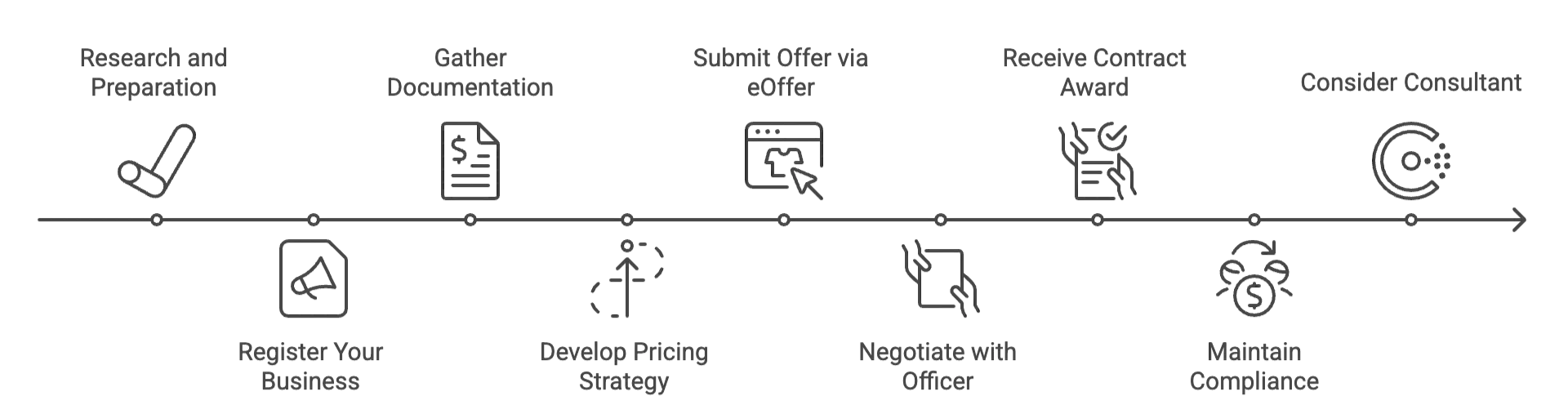
Securing a GSA contract can seem daunting, but breaking the process into clear steps makes it manageable. Here’s how you can navigate the path to becoming a GSA Schedule holder:
- Step 1: Research and Preparation: Start by researching the GSA MAS program to understand which categories and subcategories fit your products or services. Use the GSA eLibrary and GSA Advantage. to see what’s already available and identify where your offerings fill a gap or provide competitive value.
- Step 2: Register Your Business: Ensure your business is registered in the System for Award Management (SAM) and that your registration is current. You’ll also want to obtain a Unique Entity ID, and verify your NAICS codes, which classify your business type.
- Step 3: Gather Documentation: The GSA requires extensive documentation, including financial statements, past performance references, pricing data, product or service descriptions, and terms and conditions. You’ll also need to prepare your commercial sales practices (CSP) format, which outlines your standard pricing, discounts, and sales terms.
- Step 4: Develop Your Pricing Strategy: Your pricing must be competitive and comply with the Most Favored Customer (MFC) clause. Carefully analyze your current pricing structure and determine the discounts or pricing model you’ll offer to the government. Remember, the GSA will compare your proposed prices to what you charge commercial customers.
- Step 5: Submit Your Offer via eOffer: The GSA uses an online portal called eOffer (part of the GSA eBuy system) for Schedule contract applications. You’ll complete a series of forms, upload your documentation, and submit your offer electronically. Be thorough and accurate, incomplete or inconsistent submissions lead to delays.
- Step 6: Negotiate with a GSA Contracting Officer: Once your offer is submitted, a GSA contracting officer will review your submission and may request additional information or clarifications. This negotiation phase can take several weeks to months, depending on the complexity of your offer and the volume of applications the GSA is processing.
- Step 7: Receive Your Contract Award: If your offer is accepted, you’ll receive a GSA Schedule contract award. At this point, your products or services will be listed on GSA Advantage., and you can start marketing to government buyers.
- Step 8: Maintain Compliance and Reporting: After award, you’re required to report sales, update pricing and product information, and comply with contract terms. The GSA conducts periodic reviews and audits, so maintaining accurate records and staying compliant is crucial for contract renewals.
- Consider Working with a Consultant: Many businesses, especially first-timers, choose to work with GSA consultants who specialize in navigating the application process. It can save time, reduce errors, and increase your chances of approval.
Who Can Sell Through GSA Contract: Common Use Cases
GSA contracts aren’t limited to a narrow set of industries or business types. In fact, a wide variety of vendors can and do successfully sell through GSA Schedules. Here are some common use cases and examples of who benefits most:
Professional Services
- Management consulting
- Training and education
- Financial services
- Human resources
- Marketing and public relations
Information Technology
- Software licenses and SaaS
- IT consulting and implementation
- Cybersecurity services
- Cloud computing
- Hardware and equipment
Office Solutions
- Furniture and fixtures
- Office supplies
- Printing and document services
- Mail management
Industrial Products
- Tools and equipment
- Laboratory supplies
- Safety equipment
- Maintenance supplies
Specialized Fields
- Healthcare products and services
- Scientific equipment
- Law enforcement and security
- Transportation and logistics
- Facilities maintenance
Challenges and Considerations
While GSA contracts offer substantial benefits, they’re not without challenges. Before you immerse, it’s important to understand what you’re getting into and whether it’s the right fit for your business.
Pricing Compliance
The Most Favored Customer clause means you can’t offer better pricing to commercial customers without adjusting your GSA pricing accordingly. This can limit your flexibility in pricing strategies and may squeeze margins, especially if you rely heavily on promotional discounts in the commercial market.
Administrative Burden
Once you have a GSA contract, you must comply with strict reporting requirements, including quarterly sales reporting and regular updates to pricing and product catalogs. Non-compliance can lead to contract suspension or termination, so you need dedicated resources to manage these obligations.
Marketing Requirements
Unlike some government contracts, GSA schedules don’t guarantee sales. Contractors must actively market their schedule to potential government buyers.
Competitive Landscape
Holding a GSA contract doesn’t guarantee sales. You’re competing with other Schedule holders, and agencies may still conduct further competitions or request quotes from multiple vendors. Success requires active marketing, relationship building, and responsiveness to government buyer inquiries.
Compliance Risks
Failure to comply with contract terms can result in price adjustments, contract cancellation, or even False Claims Act liability in severe cases.
That’s why working with an experienced consulting partner can make all the difference. Agencies like Road Map Consulting help businesses navigate these challenges confidently, ensuring pricing compliance, managing contract modifications, staying ahead of reporting requirements, and crafting tailored marketing strategies.
FAQs About GSA Contracts
What does GSA MAS stand for in contracting?
GSA MAS stands for General Services Administration Multiple Award Schedule, the federal agency that manages government procurement and property.
What is the purpose of a GSA?
The GSA’s purpose is to help federal agencies serve the public by offering, at best value, superior workplaces, expert solutions, acquisition services, and management policies.
Can small businesses qualify for a GSA Contract?
Yes, small businesses can and do qualify for GSA contracts. In fact, approximately 38% of GSA contract dollars go to small businesses, and the GSA has specific programs to support small business participation.
How long does it take to secure a GSA Contract?
The process typically takes 2-4 months from initial submission to award, depending on offer complexity, documentation completeness, and GSA workload.
What can I sell through a GSA contract?
The GSA Multiple Award Schedule covers millions of commercial products and services across virtually all industries, from office supplies to complex professional services and IT solutions.
Road Map Consulting GSA Services

Michael Perch is the Founder and Principal of Road Map Consulting. With over 30 years of experience in financial management, sales, and contract management, Michael specializes in helping businesses navigate federal procurement processes.
Readiness Checklist
32 criteria GSA will audit – know exactly where you stand before you submit.
Join Dozens of Businesses Already Winning with Us
Our clients don't just compete—they thrive. Backed by certified processes and decades of experience, we deliver clarity, compliance, and confidence. Schedule your consultation today and see why organizations trust Road Map Consulting.