Contractor Team Arrangements (CTAs): How Federal Contractors Team Up to Win Big
Picture two companies trying to land a massive federal contract. One’s got incredible technical expertise. The other has the logistics game locked down. Separately, neither could handle the whole project. Together? They’re unstoppable.
That’s exactly what a GSA Contractor Team Arrangement makes possible.
If you’re in federal contracting, you’ve probably noticed something. The government wants specialists for everything. But they also want projects done fast and efficiently. That creates a problem. How can smaller contractors compete for those huge, complex contracts?
GSA CTAs let multiple contractors combine their strengths without merging companies. You keep your independence while accessing opportunities that would otherwise pass you by.
Let’s break down how GSA CTAs work and why they might be your ticket to bigger contracts.
What is a GSA CTA in Government Contracting?
A GSA CTA, or a contractor team agreement, is a partnership where multiple contractors team up under their existing GSA Schedule contracts to fulfill a government requirement together.
Each contractor keeps their own GSA Schedule. Nobody merges or becomes a subsidiary. You’re collaborating on a specific contract opportunity, not changing your business structure.
Think about it like forming a band. Each musician plays their instrument. They practice separately. But when they perform together, they create something bigger than any solo act could achieve.
The government sees one cohesive team. Behind the scenes, each partner handles their specialized part.
One contractor typically serves as the lead. They coordinate everything and serve as the main point of contact. The other team members support specific aspects based on their expertise.
| Step | What Happens |
|---|---|
| 1. Opportunity identified | A federal opportunity requires capabilities one contractor may not have alone. |
| 2. Contractors align capabilities | Two or more GSA Schedule holders decide how their services or products fit together. |
| 3. CTA agreement created | The team documents roles, responsibilities, pricing, invoicing, and communication. |
| 4. Proposal submitted | The team responds to the RFQ as a coordinated CTA. |
| 5. Team performs the work | Each CTA member performs the portion assigned under its own GSA Schedule contract. |
How CTAs Differ From Other Partnership Models
Federal contracting offers several ways to collaborate. Let’s compare them side by side:
| Feature | GSA CTA | Joint Venture | Prime/Subcontractor |
|---|---|---|---|
| Business Structure | Separate companies collaborating | New legal entity formed | Traditional hierarchy |
| Contract Holder | Each maintains own GSA Schedule | Joint venture holds contract | Prime holds contract |
| Liability | Each responsible for their portion | Shared joint liability | Prime bears primary liability |
| Formation Complexity | Low – simple agreement | High – requires legal entity | Medium – subcontract agreement |
| Duration | Project-specific | Can be ongoing | Project-specific or ongoing |
| Revenue Sharing | Agreed upon percentage | Partnership agreement | Negotiated rates |
| Control | Lead contractor coordinates | Joint management structure | Prime controls all aspects |
| Government Interface | Lead represents team | JV represents itself | Prime is sole point of contact |
The biggest difference? A CTA doesn’t require forming a new business entity. That saves time and paperwork.
Joint ventures make sense for long-term partnerships or multiple projects. But they require lawyers, new bank accounts, and separate tax filings.
The prime/subcontractor model works well when one company clearly dominates. But subcontractors often feel like second-class partners. They have limited visibility with the government customer.
CTAs split the difference. Each partner maintains equal standing as a GSA Schedule holder. Everyone gets credit for the work.
Real-World CTA Example
Let’s say the Department of Veterans Affairs needs a complete IT infrastructure overhaul. They want new servers, cybersecurity implementation, ongoing support, and training for 500 employees.
That’s a $10 million project spanning three years.
- Company A specializes in hardware installation and server management.
- Company B excels at cybersecurity.
- Company C provides training services.’
Individually, none could handle the entire contract. Together, they form a GSA CTA.
Company A serves as the lead. They submit the proposal showing how their team covers every requirement. The VA gets one coordinated team instead of juggling three separate contracts.
Each company bills for its portion using its own GSA Schedule.
- Company A invoices for hardware.
- Company B for security services.
- Company C for training.
The VA writes three separate checks based on the CTA agreement. But they only manage one relationship with the lead contractor.
Everybody wins. The contractors land a huge opportunity. The VA gets specialized expertise across the board.
GSA CTA Eligibility Requirements
Not every contractor can jump into a GSA CTA. The GSA has specific rules about who qualifies.
- First and foremost: All CTA members must be approved GSA Multiple Award Schedule holders. No exceptions. You can’t team up with a great company that lacks a GSA Schedule. They need to get approved first.
Beyond that basic requirement, here’s what matters:
- Active Schedule Status – Your GSA Schedule must be current and in good standing. If you’re dealing with compliance issues or past-due modifications, fix those first.
- Compatible Special Item Numbers (SINs) – The products or services you offer under your Schedule must align with the contract opportunity. A company with IT SINs can’t suddenly claim construction expertise.
- Capability Demonstration – Each team member must prove they can deliver their portion. Past performance matters here. The government wants evidence you’ve done similar work.
- Clear Role Definition – The CTA agreement must specify exactly what each partner does. Vague responsibilities raise red flags during evaluation.
- Pricing Transparency – Each contractor must identify which portions of the overall price come from their Schedule. The government needs to see the breakdown.
Required CTA Information
According to GSA guidelines, all GSA CTAs should include the following information:
- Team Member Identification – Full legal names, GSA Schedule numbers, and contract details for each partner.
- Roles and Responsibilities – Specific description of what each team member provides. Be detailed. “IT support” isn’t enough. “24/7 help desk services for 500 users with 2-hour response time” works better.
- Lead Contractor Designation – Clearly state which company leads the team and why they’re qualified for that role.
- Percentage Breakdown – Show what percentage of work each partner handles. This helps the government understand team dynamics.
- Communication Protocol – Explain how the team coordinates internally and who handles government communications.
- Pricing Structure – Detail how pricing works, including which Schedule each component comes from.
- Key Personnel – Identify critical staff from each organization and their qualifications.
- Past Performance – Provide relevant past performance examples for each team member in their area of responsibility.
The GSA reviews this information to ensure your team meets requirements. Complete, detailed CTAs sail through approval. Vague ones get questioned.
Benefits of Using a GSA CTA
Why bother with a CTA instead of going solo? The advantages stack up quickly for both contractors and government agencies.
For Contractors: Access to Bigger Opportunities
The most obvious benefit? You can pursue contracts that would otherwise exceed your capacity.
Small businesses face this constantly. A perfect opportunity appears, but it requires capabilities you don’t have. Or maybe the scale is too large for your current team.
CTAs remove that barrier. You combine resources without the commitment and complexity of merging companies.
- Expanded Technical Capabilities – Partner with specialists in areas where you’re weak.
- Increased Bonding Capacity – Large contracts often require performance bonds. By splitting the work, each company only needs to bond their portion.
- Reduced Risk – Sharing a big contract spreads the risk. If one aspect faces challenges, the whole team doesn’t sink.
- Learning Opportunities – Working closely with other contractors exposes you to new approaches. Many successful CTAs lead to long-term informal partnerships.
- Maintained Independence – Unlike joint ventures, you keep complete control of your company. No shared ownership. No complicated exit strategy.
For Government Agencies: Streamlined Procurement
Federal buyers benefit significantly from CTAs too. That’s why many agency contracting officers actively encourage them.
- One Point of Contact – Instead of managing multiple contracts, the agency deals with the lead contractor. That simplifies communication and reduces administrative burden.
- Access to Specialized Skills – The government gets best-in-class capability for each project component. They’re not settling for one contractor’s weaker areas.
- Faster Implementation – CTAs typically hit the ground running faster than single contractors scrambling to subcontract after award.
- Reduced Protest Risk – Well-structured CTAs often face fewer protests because the team clearly demonstrates superior capability.
- Better Overall Value – Competition between CTA teams often drives better pricing than single contractors marking up subcontractor work.
How to Form a GSA CTA?
Ready to create your own CTA? Follow this step-by-step process to set up a partnership that wins contracts.
Step 1: Understand the Regulations
Before anything else, familiarize yourself with the rules governing CTAs.
The primary guidance comes from Federal Acquisition Regulation (FAR) 9.6, which covers contractor team arrangements. The GSA also provides specific guidance for Schedule holders.
Key regulatory points include:
- CTAs must identify all team members in proposals
- Each member’s role must be clearly defined
- Pricing must be transparent and traceable to GSA Schedules
- The government reserves the right to approve or reject team composition
- Post-award changes to team composition require government approval
Spend time reading the actual regulations, not just summaries. The FAR is available free online. The GSA provides excellent resources on their website.
Step 2: Choose the Right Partners
Your CTA is only as strong as its members. Choose partners carefully.
- Complementary Capabilities – Look for companies that fill gaps in your offerings. The ideal partner excels where you’re weak and vice versa.
- Compatible Culture – You’ll work closely together on proposals and execution. Wildly different business cultures create friction.
- Similar Size and Capacity – Partnerships work best when companies bring relatively equal value. Huge imbalances create tension.
- Proven Track Record – Each partner should have solid past performance. One weak link drags down the whole team.
- Financial Stability – Check that potential partners have healthy finances. You don’t want someone folding mid-project.
- Clear Communication – During preliminary discussions, pay attention to responsiveness and clarity. If communication is hard now, it’ll be worse under pressure.
- Geographic Alignment – For contracts with site work, consider whether partners have presence in relevant locations.
Start with informal conversations. Discuss business philosophy, capacity, and goals. Make sure everyone’s on the same page before committing.
Step 3: Draft a Comprehensive CTA Agreement
Once you’ve selected partners, document everything in a detailed CTA agreement.
You need a written agreement that covers:
- Scope Definition – Precisely describe what each partner provides. Use measurable terms.
- Lead Contractor Designation – State who leads and their specific responsibilities.
- Financial Terms – Detail how revenue splits between partners. Include payment timing and any milestone-based distributions.
- Intellectual Property – Clarify who owns what, especially for any jointly developed solutions.
- Dispute Resolution – Establish a process for handling disagreements without involving the government customer.
- Termination Provisions – Explain what happens if the CTA needs to end, whether before or after contract award.
- Insurance and Liability – Define insurance requirements and how liability is shared or separated.
- Key Personnel – Identify critical staff and what happens if they become unavailable.
- Communication Protocols – Establish clear channels for internal communication and government interaction.
- Change Management – Create a process for handling scope changes or government modifications.
Have a lawyer review this agreement. The upfront legal cost is tiny compared to the headaches caused by a poorly written agreement.
Step 4: Prepare the Team Capability Statement
Before pursuing specific opportunities, create a team capability statement. This document showcases your combined strengths.
Include:
- Brief company profiles for each partner
- Combined capabilities overview
- Relevant past performance from all team members
- Key personnel across the team
- Geographic coverage
- Total team capacity (employees, facilities, bonding)
- Unique team differentiators
Format this professionally. Use it when introducing your CTA to agency contracting officers or responding to requests for information.
Step 5: Register Your Team Agreement
The GSA requires teams to document their arrangement when submitting proposals. This typically happens through the electronic proposal system.
The specific submission requirements vary by solicitation. Always follow the exact instructions in the Request for Proposal (RFP).
Generally, you’ll need to:
- Complete any required team arrangement forms
- Submit your CTA agreement (sometimes redacted versions are acceptable)
- Provide GSA Schedule information for all members
- Include capability statements and past performance for each partner
- Detail your pricing methodology
Double-check that all required signatures are in place. Missing signatures are a common reason for proposal disqualification.
Step 6: Submit a Winning Proposal
With your CTA formalized, you’re ready to respond to opportunities.
Your proposal must clearly communicate why the team approach provides superior value. Highlight how combined capabilities exceed what any single contractor offers.
- Address Team Coordination – Explain how you’ll work together seamlessly. The government worries about team coordination failures.
- Showcase Complementary Strengths – Demonstrate how each partner’s expertise directly addresses specific requirements.
- Provide Team Past Performance – Include relevant examples from each member. Show parallel successful teamwork if possible.
- Detail Transition Plans – Explain how work hands off between team members smoothly.
- Emphasize Communication – Describe your coordination approach and single point of contact structure.
- Price Competitively – Your combined pricing should beat what single contractors would charge when subcontracting.
Remember, you’re selling the team concept as much as the solution itself. The evaluators must believe your CTA offers advantages over single-contractor approaches.
Need Help? Road Map Consulting Services
Forming a GSA CTA sounds straightforward on paper. But the reality involves nuances that can trip up even experienced contractors.
You’re juggling regulatory compliance, partner selection, agreement negotiation, and competitive positioning all at once. Miss one critical element and your team might not even make it past the initial evaluation.
That’s where Road Map Consulting comes in:

Pamela, Senior Contracts Manager at Road Map Consulting, specializes in GSA MAS and VA FSS programs. She manages federal contract acquisition, supports post-award compliance, and helps clients streamline workflows, ensure audit readiness, and mitigate risks for long-term success.
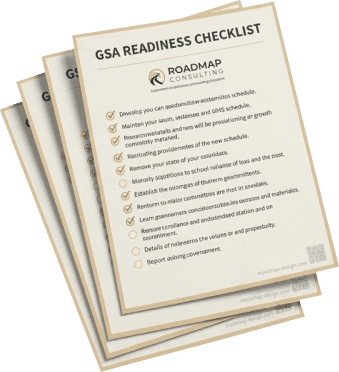
Readiness Checklist
32 criteria GSA will audit – know exactly where you stand before you submit.
Join Dozens of Businesses Already Winning with Us
Our clients don't just compete—they thrive. Backed by certified processes and decades of experience, we deliver clarity, compliance, and confidence. Schedule your consultation today and see why organizations trust Road Map Consulting.