How to Find Government Contracts (for GSA Holders)
You won your GSA Schedule. Now agencies have to find you and actually buy from you, and that part does not happen on its own. Holding a Schedule opens doors that closed bidders never see, from GSA eBuy quotes to faster ordering, but the opportunities still have to be found and pursued. This guide covers where government contracts show up, how to search them, and how a GSA holder can focus on the work worth winning.
Why Finding the Right Contracts Matters
A GSA Schedule is only as valuable as the orders placed against it. The federal government is one of the largest buyers in the world, so the problem is rarely a shortage of notices. The problem is sorting the few opportunities worth your time from the hundreds that are not. A business that pursues every posting burns hours on bids it was never positioned to win. A holder that targets the right agencies, codes, and vehicles turns a dormant Schedule into a pipeline it can convert. Knowing where to look is step one. Knowing what to skip is step two.
Where to Find Government Contracts
Government contract opportunities sit across several official systems, and each one does a different job. Learning what each covers keeps you from checking the wrong place or missing bids entirely.
SAM.gov
The System for Award Management (SAM.gov) is the primary federal site for contract opportunities. Agencies post sources sought notices, presolicitations, full solicitations, and award notices here. Most federal work runs through it, so any business pursuing federal contracts starts with an active SAM.gov entity registration and a saved-search routine. You can browse notices without registering, though active registration is normally required before you can submit a bid.
GSA eBuy
This is where your Schedule earns its keep. GSA eBuy gives Schedule holders access to Requests for Quote that agencies send directly to them, and many of these never appear as open solicitations on SAM.gov. Your visibility depends on the Special Item Numbers (SINs) on your contract, so a well-built Schedule surfaces more of these quotes. Not on the Schedule yet? Our guide on how to get on the GSA Schedule covers the steps.
USASpending.gov
USASpending.gov is a research tool, not a bid board. Use it to see which agencies buy what you sell, who won similar contracts, how large those awards were, and when a contract might come up again. That history points you toward agencies with a real record of buying your product or service, rather than agencies you assume might.
Agency Procurement Forecasts
Federal agencies publish procurement forecasts that signal what they plan to buy in the months ahead. Acquisition.gov links to each agency’s forecast page. Formats vary from one agency to the next, so some take more digging than others, but a forecast lets you position your firm before a solicitation is ever released.
How to Search for Government Contracts on SAM.gov
Finding contracts is less about checking every posting and more about a repeatable search you run often. A few steps make SAM.gov work harder for you.
- Register your entity. Set up a SAM.gov account and complete your entity registration, which ties to your business through a UEI and a CAGE code. Active registration is what lets you bid.
- Search by code, not just keywords. Build your searches around your NAICS codes and, where they apply, Product Service Codes (PSCs). Agencies classify work by these codes, so the wrong ones hide good opportunities from you.
- Filter down to real fits. Narrow results by agency, notice type, set-aside, posted date, and response date. A short list of qualified notices beats a long list of loose matches every time.
- Save your searches and set alerts. Save each search and turn on email notifications so new notices reach you without a manual check every day.
- Read the notice before you commit. Check the scope, due date, attachments, and instructions. A sources sought notice is market research, not a solicitation, so treat it differently from a Request for Proposal. Watch for amendments that change dates or terms after the first posting.
Government Contract Opportunities Beyond Federal Solicitations
Open federal bids are one slice of the market. Several other channels hold opportunities that fit newer or smaller firms well, and they work whether or not you already hold a Schedule.
Subcontracting
Prime contractors on large awards are often required to subcontract part of the work to small businesses. SBA SUBNet lists these subcontracting opportunities, and many agencies publish their own subcontracting directories. For a firm building past performance, subcontracting is frequently the fastest way in.
Teaming Partners
Some contracts call for a mix of capabilities, past performance, or geographic coverage that no single firm has. Partnering with a prime, or bringing on a subcontractor of your own, lets you pursue work you could not reach alone. Spotting the right partners early is part of how our team builds a pipeline for clients through federal opportunity research.
State and Local Portals
Cities, counties, school systems, and state agencies run their own procurement portals with their own rules. For many businesses, these bids carry lighter competition than federal work and build a track record you can point to later.
How to Get Government Contracts as a Small Business
Small firms are not shut out of federal work. The rules are built to bring them in, and a focused approach beats chasing every notice.
Set-Aside Programs
Set-asides reserve certain contracts for eligible small businesses. Programs run through the SBA include 8(a) for socially and economically disadvantaged firms, HUBZone for businesses in qualified areas, WOSB for women-owned small businesses, and SDVOSB for service-disabled veteran-owned small businesses. Confirm your eligibility through SBA.gov before you market your firm under any program.
Your Codes and Your Schedule Working Together
Your NAICS codes shape what you see and how agencies classify you, so keep them accurate. Your GSA Schedule then gives agencies a fast, trusted way to buy from you once they find you. The two work as a pair: accurate codes surface the right opportunities, and the Schedule makes you easy to award. Winning a Schedule does not guarantee orders, though it opens the door to recurring buying and to GSA eBuy quotes.
From Finding Contracts to Winning Them
A found opportunity is only the start. The firms that win qualify each pursuit before they commit, then respond with a compliant, well-built proposal.
The decision of whether an opportunity is worth your time comes down to scope fit, competition, past-performance requirements, and the effort a bid takes. Our team handles that qualification through federal opportunity research, then supports the response through proposal development, so your effort goes where the odds are best.
Find Government Contracts With Road Map Consulting
Searching, qualifying, and pursuing federal work is close to a full-time job on top of running your business. RMC’s Federal Marketing and Capture Management Support acts as your outsourced federal business development team. We research opportunities across federal, state, and local sources, match them to your capabilities and contract vehicles, and hand you a clear pipeline of pursuits worth your time.
Since 2009, we have helped more than 300 firms turn a GSA Schedule into an active federal pipeline. Schedule a call, and we will review your current standing and map the opportunities that fit your firm.
Frequently Asked Questions About Finding Government Contracts
Where can I find government contracts?
Start with SAM.gov, the main federal site for open notices and solicitations. From there, add GSA eBuy if you hold a GSA Schedule, SBA SUBNet for subcontracting leads, USASpending.gov for award research, and your state and local procurement portals for non-federal work.
How do I get government contracts as a GSA Schedule holder?
Monitor GSA eBuy for Requests for Quote tied to your SINs, keep your NAICS codes and GSA Advantage listings accurate, and pair that with saved SAM.gov searches. Holding the Schedule gets you a faster buying route, but the orders still come from active pursuit.
Do I need a GSA Schedule to find government contracts?
No. Agencies post work on SAM.gov that any registered business can pursue. A GSA Schedule adds a faster buying route and access to eBuy quotes, so it helps for recurring sales, but it is not a requirement to compete.

Michael Perch is the Founder and Principal of Road Map Consulting. With over 30 years of experience in financial management, sales, and contract management, Michael specializes in helping businesses navigate federal procurement processes.
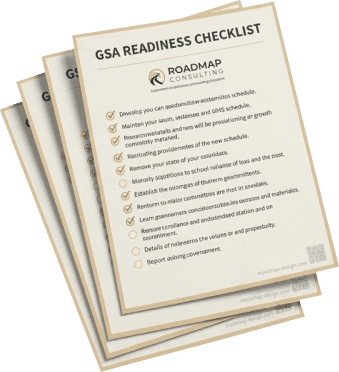
Readiness Checklist
32 criteria GSA will audit – know exactly where you stand before you submit.
Join Dozens of Businesses Already Winning with Us
Our clients don't just compete—they thrive. Backed by certified processes and decades of experience, we deliver clarity, compliance, and confidence. Schedule your consultation today and see why organizations trust Road Map Consulting.